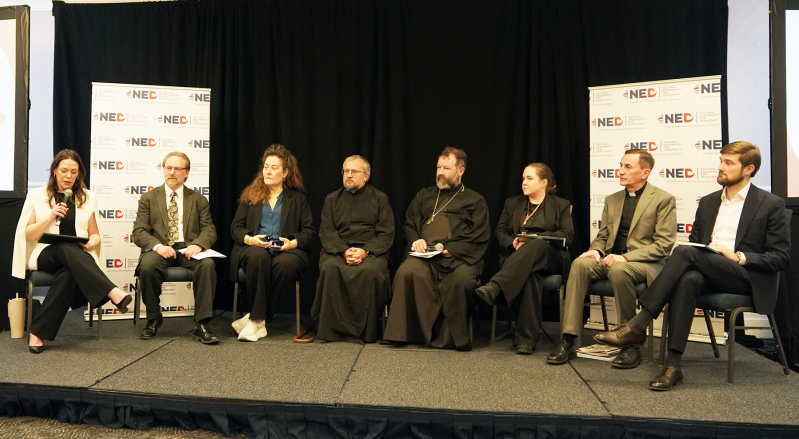
Panelists take part in the affiliated session “The Kremlin’s Use of the Russian Orthodox Church in the War Against Ukraine,” sponsored by the National Endowment for Democracy, during the International Religious Freedom Summit on Feb. 3, examining how religious institutions are being instrumentalized by the Russian state to justify war and suppress dissent at home and abroad.
The regime of Vladimir Putin is using the Russian Orthodox Church in efforts to repress other faiths not only in Ukraine and other foreign countries but within Russia’s borders, clergy and rights defenders said.
Dmytro Koval, co-director of Truth Hounds, a Ukrainian human rights organization documenting Russian crimes in Ukraine, told participants at the International Religious Freedom Summit on Feb. 3 that Kremlin use of the Russian Orthodox Church goes back to early years of occupation in eastern Ukraine in 2014 and prior.
“There were for instance units called the Russian Orthodox Army, and it’s institutionally connected to the Russian Orthodox Church,” Koval said. “And these units, again, they practically realized this doctrine of a Russian world and this new Russian imperialism, this new Russian attempt to rebuild the empire, either Soviet or Russian; these forces showed us how the church is used and how it’ll be used in the future to come.”
The Russian Orthodox Army, a Russian separatist paramilitary group founded in 2014 fighting Ukrainian forces in Donbas, was reportedly later absorbed into the Oplot Fifth Separate Infantry Brigade. It is used to mobilize the Russian population and Russians in the occupied territory to take active part in the war and give their lives for the causes of the Kremlin, Koval said.
“What is quite interesting is the language used in the Russian Orthodox Army – they were talking about crusade, but in their imagination that crusade had its enemy not only in Ukraine but also in the West,” Koval said. “So basically, the crusade had to continue beyond Ukraine in Western Europe, but also the U.S. was always mentioned.”
Understanding how Russian occupation has impacted religious freedom – including killing of church leaders and other Christians and closing churches – is key to understanding Ukrainian resilience and opposition to “so-called peace talks” with Russia, he said.
“One of the reasons why Ukraine is so unapologetic regarding [opposition to] any territorial deals, it’s because Ukraine is fighting not for territory, but for people,” Koval said. “And very much was learned from this eight to 10 years’ experience of occupation before the full scale invasion – what the occupation actually means for people, including what it means for the freedom of the region.”
Russia has long wanted to repress religion beyond its borders, as a 2017 U.S. Commission on International Religious Freedom report noted, he said.
“What is sad in that report is that Russia is one of the few states that is not only organizing repressions in the country, but it’s also exporting religious persecution,” he said.
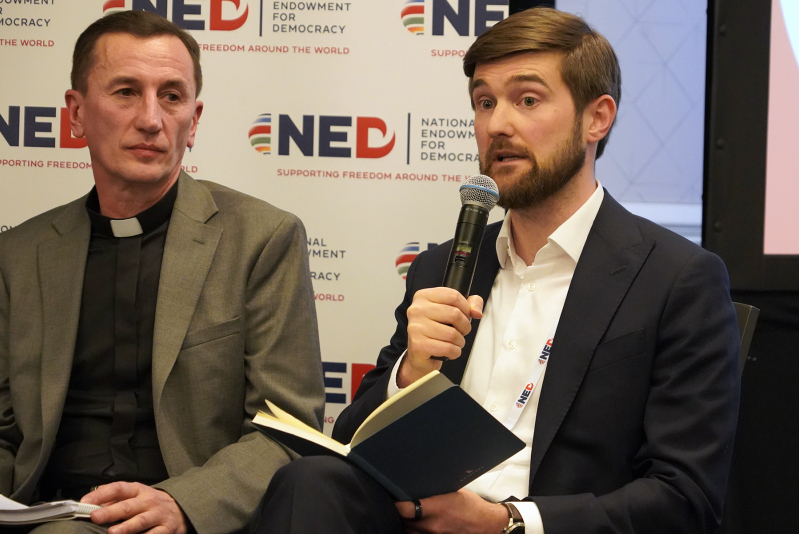
Dr. Dmytro Koval (right), co-director of the Ukrainian human rights group Truth Hounds, speaks during the International Religious Freedom Summit on Feb. 3 about the Kremlin’s use of the Russian Orthodox Church to legitimize occupation and repression in Ukraine, describing how religious language and institutions have been mobilized to advance Russian imperial ideology.
“One of the reasons why Ukraine is so unapologetic regarding [opposition to] any territorial deals, it’s because Ukraine is fighting not for territory, but for people,” Koval said. “And very much was learned from this eight to 10 years’ experience of occupation before the full scale invasion – what the occupation actually means for people, including what it means for the freedom of the region.”
Russia has long wanted to repress religion beyond its borders, as a 2017 U.S. Commission on International Religious Freedom report noted, he said.
“What is sad in that report is that Russia is one of the few states that is not only organizing repressions in the country, but it’s also exporting religious persecution,” he said.
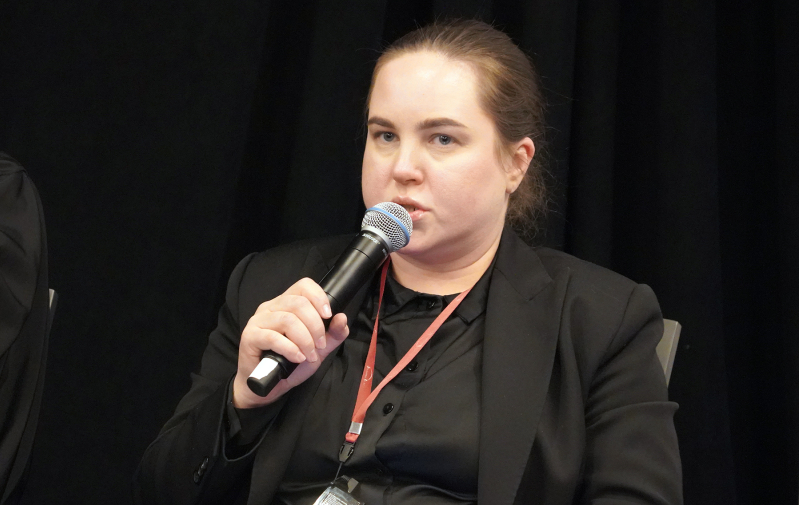
Dr. Vira Iastrebova, director of the Eastern Human Rights Group, addresses participants at the International Religious Freedom Summit on Feb. 3, warning that the Russian Orthodox Church is being used to militarize children and youth through paramilitary camps that combine weapons training with ideological indoctrination.
Vira Iastrebova, director of the Eastern Human Rights Group, told the summit that the Russian Orthodox Church has become a tool of militarizing young people by implementing various youth programs and paramilitary clubs.
“One is called Camps, Et cetera; one is called Orthodox Warriors,” Iastrebova said. “And in those camps and programs, children are trained to use firearms and also are indoctrinated in ideologies of hatred and violence. Understandably, this is going to have very grave consequences for the future that we must take into account as we focus our attention on reunification of Ukraine’s territories and working towards better freedoms for all people of faith.”
The Rev. Andrey Kordochkin, a Russian Orthodox priest based in Europe who was sanctioned and suspended from the Moscow patriarchate after co-authoring an open letter condemning Russia’s invasion of Ukraine, told participants that the Kremlin’s use of the patriarchate goes as far as propaganda found in official prayers.
“If you look at the text of the prayer which was introduced in September 2022, you can see that liturgically, it has a form of a prayer, but in fact it’s political declaration,” Kordochkin said, noting that it implicitly denies the existence of Ukraine as a country. “Then this prayer also presents Russia not as an aggressor but as a victim of some hostile forces that had wanted to destroy it in a conspiracy kind of mindset.”
Most importantly, he said, the liturgical prayer speaks about victory rather than reconciliation. A priest obliged to read the prayer changed the word “victory” to “peace” and was defrocked, he said.
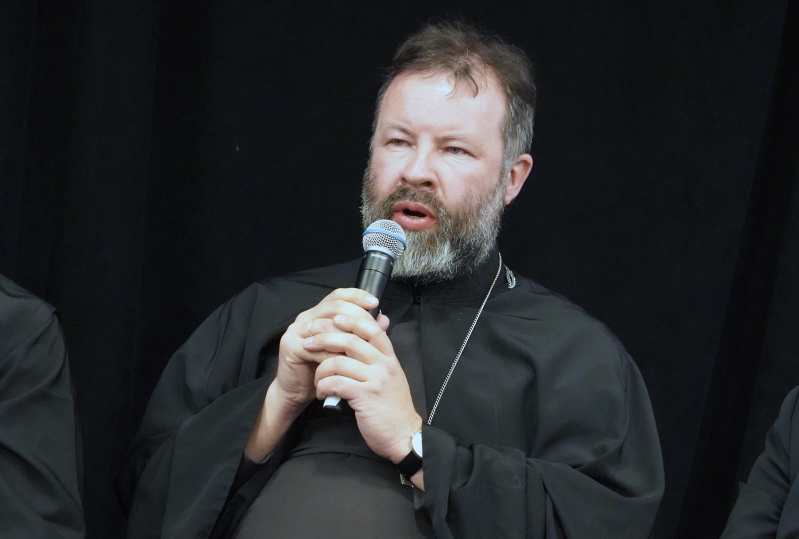
The Rev. Andrey Kordochkin, a Russian Orthodox priest suspended by the Moscow patriarchate for opposing Russia’s invasion of Ukraine, speaks at the International Religious Freedom Summit on Feb. 3, criticizing state-mandated prayers that frame the war as a sacred struggle and punish clergy who call for peace rather than victory.
“Now a spokesman for the Moscow patriarchate, when he was asked by a journalist whether these punishments upon these priests are not too cruel, said, ‘Well, the church is like the army. If people in the army give an oath and if they do something that goes contrary to it, they have to pay the price, and the priest and the deacons before they’re being ordained, they also give this oath.’ So, the patriarchate itself is describing itself in kind of paramilitary terms.”
Recently Moscow Patriarch Kirill said those who question the national consensus in Russia should be treated as betrayers of the motherland, Kordochkin noted.
“Now, betrayal of motherland is not a moral term, it’s a legal term because it’s a criminal article which implies punishment up to a death sentence,” he said. “So, you can see this repressive symphony in both the church institution and the state.”


No comments:
Post a Comment