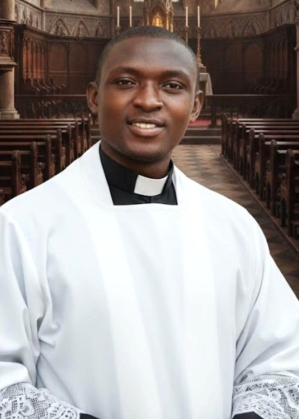
The Rev. Bobbo Paschal, Catholic priest released
from captivity in Kaduna state, Nigeria on Jan. 17, 2026.
Christians in a village in Nigeria remain traumatized by violence even as a priest held hostage for 61 days was released last month, sources said.
The Rev. Bobbo Paschal of St. Stephen Catholic Parish in Kushe Gugdu village, Kagarko County, Kaduna state was released on Jan. 17 after terrorists kidnapped him on Nov. 17, according to the Catholic Archdiocese of Kaduna.
Innocent Yakubu, a community leader in Kushe Gugdu, close to Kubacha, said Fulani herdsmen invaded the village and killed another Christian on the day they kidnapped Paschal.
“It has thrown the entire community into fear, sorrow, and uncertainty “The entire community remains traumatized as we continue to search for safety that no longer exists.”
In the kidnapping of Paschal as he prepared for the morning Mass in the early hours of Nov. 17, church member Gideon Markus was killed and two other congregants were kidnapped and remain in captivity, according to leaders of the archdiocese.
Yakubu said the village has suffered repeated attacks by Fulani assailants for many years that have claimed lives and destroyed livelihoods, he said.
“Christians here now live in constant fear because violence has become a recurring nightmare,” Yakubu said. “Our land is bleeding, our hearts are broken and our communities are losing hope.”
The kidnapping of Paschal was not the first time a priest or resident has been abducted in Kushe and surrounding villages, he said.
Sunday Audu, another area resident, said herdsmen in late January and early February also attacked Aribi, Ungwan Pah, Dogon Daji and Kurmin Lemu villages.
The 166 Christians kidnapped by armed Muslim terrorists in Kurmin Wali village, Kaduna state were released in the early hours of Thursday (Feb. 5), the Rev. Joseph Hayab, chairman of the Christian Association of Nigeria (CAN), Northern Nigeria chapter, said in a statement.
“All the 166 Christians kidnapped by terrorists in Kurmin Wali community have now been released,” Hayab said. “They are currently being attended to in a military hospital, after which they will be transferred to the Kaduna State Government and subsequently, to be released to their families.”
The Christian leader, a Baptist pastor, said no ransom was paid by churches for the release of the captives, but that the government that handled the negotiations with the terrorists.
The Christians were kidnapped on Jan. 18 while attending church worship services.
Congressional Hearing
At a hearing of the U.S. House Foreign Affairs Committee on Feb. 4, religious liberty advocates spoke of recurring killings, abductions and mass displacement in Nigeria.
Former U.S. Ambassador-at-Large for International Religious Freedom Sam Brownback described Nigeria as a frontline of global terrorism with militant Islamist groups expanding their attacks across Africa and the Middle East.
“The deadliest place on the planet to be a Christian is Nigeria; early warning signs of a Muslim-on-Christian war are emerging across Africa, and Nigeria sits at the center of that danger,” Brownback said.
Radical, militant Islam continues its “purification efforts” throughout the Middle East North Africa region and beyond, he said. “Syria and Nigeria are key focus areas in their quest for dominance, excluding all other faiths.”
Stephen Schneck, former chair of the U.S. Commission on International Religious Freedom (2024 to 2025), said at the hearing that freedom of religious expression is facing a global crisis propelled by authoritarianism, religious nationalism and weak state institutions.
“Nigeria, Syria and Sudan are examples of countries where poor governance and widespread insecurity have created dangerous conditions for communities of faith,” Schneck said.
Committee Chairman Chris Smith (R-NJ) recommended the U.S. address the “culture of denial” by Nigerian officials despite mass killings of Christians by Boko Haram, Islamic State West Africa Province (ISWAP) and Fulani militants; sustain and enforce the designation of Nigeria as a Country of Particular Concern (CPC); apply International Religious Freedom Act policy tools such as sanctions, economic penalties against Nigerian entities enabling or tolerating religious freedom violations; compel Nigeria to protect Christians and moderate Muslims from religiously motivated violence; urge Nigerian authorities to prosecute perpetrators and prevent attacks in Christian communities; and monitor and curb influence by China, Russia, Turkey and Saudi Arabia, which are exacerbating instability in Nigeria.
At the same time, a petition by the American Center for Law and Justice (ACLJ) before the United Nations on genocide against Christians in Nigeria received wide acceptance within 16 hours of its filing, according to ACLJ President and CEO Jordan Sekulow.
Within a day of the petition being posted on the ACLJ website, more than 517,000 signatures have been gathered, with the target of 750,000 signatures expected.
Saying 90 percent of all Christians killed worldwide are in Nigeria, Sekulow said Christians live in a constant state of terror, fearing abduction, torture and murder by radical Islamic jihadists, including Fulani herdsmen.
Numbering in the millions across Nigeria and the Sahel, predominantly Muslim Fulani comprise hundreds of clans of many different lineages who do not hold extremist views, but some Fulani do adhere to radical Islamist ideology, the United Kingdom’s All-Party Parliamentary Group for International Freedom or Belief (APPG) noted in a 2020 report.
“They adopt a comparable strategy to Boko Haram and ISWAP and demonstrate a clear intent to target Christians and potent symbols of Christian identity,” the APPG report states.
Christian leaders in Nigeria have said they believe herdsmen attacks on Christian communities in Nigeria’s Middle Belt are inspired by their desire to forcefully take over Christians’ lands and impose Islam as desertification has made it difficult for them to sustain their herds.
More Christians were killed in Nigeria than in any other country from Oct. 1, 2024 to Sept. 30, 2025, according to Open Doors’ 2026 World Watch List. Of the 4,849 Christians killed worldwide for their faith during that period, 3,490 – 72 percent – were Nigerians, an increase from 3,100 the prior year. Nigeria ranked No. 7 on the WWL list of the 50 countries where it is most difficult to be a Christian.
In the country’s North-Central zone, where Christians are more common than they are in the North-East and North-West, Islamic extremist Fulani militia attack farming communities, killing many hundreds, Christians above all, according to the report. Jihadist groups such as Boko Haram and the splinter group Islamic State in West Africa Province (ISWAP), among others, are also active in the country’s northern states, where federal government control is scant and Christians and their communities continue to be the targets of raids, sexual violence, and roadblock killings, according to the report. Abductions for ransom have increased considerably in recent years.
The violence has spread to southern states, and a new jihadist terror group, Lakurawa, has emerged in the northwest, armed with advanced weaponry and a radical Islamist agenda, the WWL noted. Lakurawa is affiliated with the expansionist Al-Qaeda insurgency Jama’a Nusrat ul-Islam wa al-Muslimin, or JNIM, originating in Mali.


No comments:
Post a Comment